
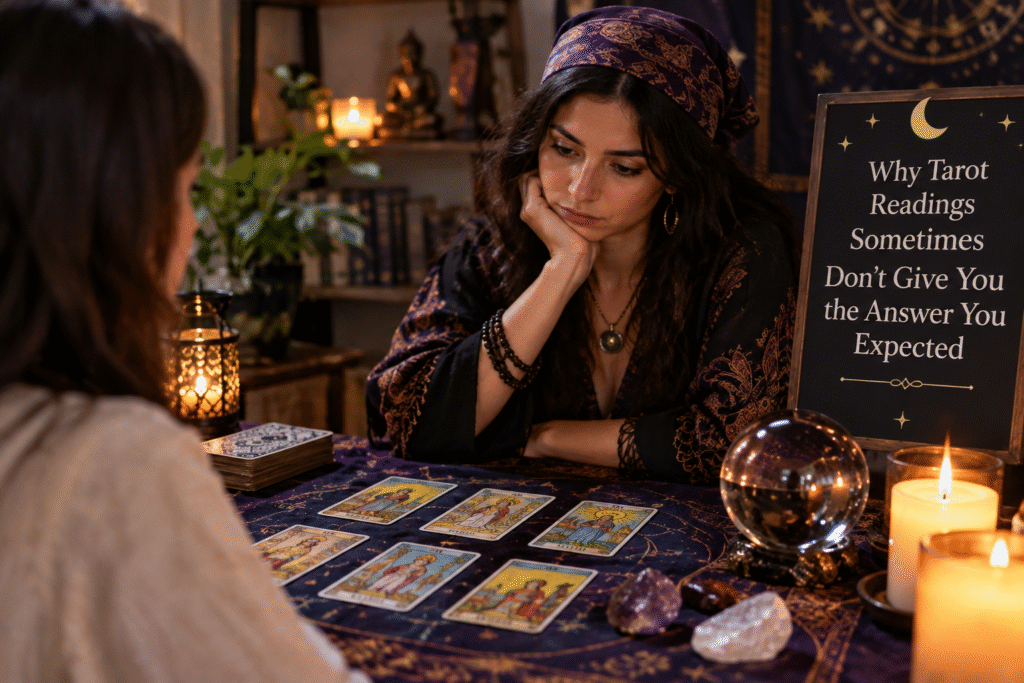
Why Tarot Readings Sometimes Feel Unexpected
Many people turn to tarot readings with a clear question in mind. They may want to know whether a relationship will work, whether a career opportunity is coming, or what might happen next in their lives.
Sometimes, however, the cards do not appear to provide the direct answer they were hoping to receive.
Instead, the reading may highlight a completely different issue. A card can point toward uncertainty, personal fears, communication problems, patience or a need for change. This can feel confusing, especially when someone is looking for a simple “yes” or “no.”
Understanding this experience can make tarot more meaningful. Rather than treating every reading as a guaranteed prediction, many people use tarot as a tool for reflection, symbolism and exploring different perspectives.
Tarot Does Not Always Work Like a Yes-or-No System
One common reason for an unexpected tarot answer is the type of question being asked.
Tarot cards are traditionally interpreted through symbols, themes and relationships between cards. Many spreads are designed to explore a situation rather than produce a simple yes-or-no response.
For example, someone might ask, “Will I get this job?” The cards might instead seem to focus on preparation, competition, confidence or a different career direction.
That does not necessarily mean the reading failed. It may simply mean the question contains several parts that cannot easily be reduced to one answer.
A useful follow-up question could be, “What should I understand about this career opportunity?” This changes the focus from demanding a prediction to exploring the situation.
Your Expectations Can Affect the Experience
Expectations can strongly influence how a tarot reading feels.
When someone has already imagined a particular outcome, they may naturally hope the cards will confirm it. If the cards appear to suggest something else, disappointment can follow.
This is a normal human reaction. People generally prefer information that fits what they already believe or want.
Tarot can sometimes encourage a different perspective by drawing attention to themes that a person has not considered. A card connected with uncertainty, endings or difficult choices may feel uncomfortable, but it can also encourage deeper reflection.
The important point is that the reader and the person receiving the reading may interpret the symbolism differently.
Card Meanings Are Not Always Literal
Another reason tarot readings may seem confusing is that tarot card meanings are symbolic rather than fixed sentences.
A card often has several possible interpretations depending on the question, its position in a spread and the cards around it.
For example, the Death card is commonly associated with transformation, endings and transition. It does not necessarily mean a literal death. Similarly, The Tower can symbolize sudden change, disruption or the collapse of an old situation.
Because individual cards can have multiple meanings, a reading may not provide the straightforward message someone expected.
Context matters.
The Same Card Can Mean Different Things
A tarot card does not always mean exactly the same thing for every person.
Imagine drawing the Eight of Cups during a relationship reading. One interpretation might involve walking away from something emotionally unfulfilling. Another might focus on emotional growth, taking space or searching for a deeper purpose.
The surrounding cards can change the interpretation further.
This is why experienced readers often consider the whole spread rather than focusing on one card in isolation.
The unexpected answer may therefore come from the overall story created by the cards rather than from a single image.
Emotions Can Influence Interpretation
Emotional state can also affect how a reading is understood.
Someone experiencing anxiety may focus on the most negative interpretation of a card. A hopeful person may emphasize its positive possibilities.
For this reason, tarot readings can sometimes say as much about the person’s current concerns as they do about the cards themselves.
Taking notes and revisiting the reading later may help. Once strong emotions have settled, a person may notice meanings that were difficult to see during the original session.
Sometimes the Question Needs to Change
A very specific question can sometimes make a reading feel frustrating.
Questions such as “Exactly when will this happen?” or “What exact decision will another person make?” may encourage a search for certainty that tarot cannot reliably provide.
A broader question can be more useful.
Instead of asking, “Will my partner contact me tomorrow?” someone might ask, “What can I understand about the current communication in this relationship?”
The second question creates room for reflection without requiring an exact prediction.
An Unexpected Answer Can Be Useful
Not getting the expected answer can sometimes be the most interesting part of a reading.
A person may discover that they are asking about one problem while actually worrying about another. A career question may reveal concerns about confidence. A relationship question may highlight communication or personal boundaries.
In this sense, tarot can function as a prompt for self-examination.
The cards can encourage someone to pause and think about choices, emotions and possible perspectives. The value may come from the reflection rather than from proving that the cards can predict future events.
Do You Need Another Reading?
When a reading feels unclear, some people immediately ask for another spread.
Repeating the same question many times, however, can make the process more confusing. Different readings can produce different symbolic combinations, especially when emotions and expectations have changed.
Instead of repeatedly asking the same question, it may be more useful to step back and consider what was already revealed.
Writing down the reading, identifying the main themes and thinking about practical next steps can provide more clarity.
For important matters involving health, finances, legal issues or major life decisions, tarot should not replace qualified professional advice or reliable information.
Final Thoughts
Tarot readings do not always give people the answer they expect, and that can be part of their appeal.
Cards are interpreted through symbolism, context and personal reflection. A reading may seem unclear because the question is too narrow, emotions are influencing interpretation, or the cards are highlighting a different aspect of the situation.
Instead of seeing an unexpected answer as automatically wrong, it can be viewed as an invitation to look at the question from another angle.