Why Does the Same Tarot Card Keep Appearing?
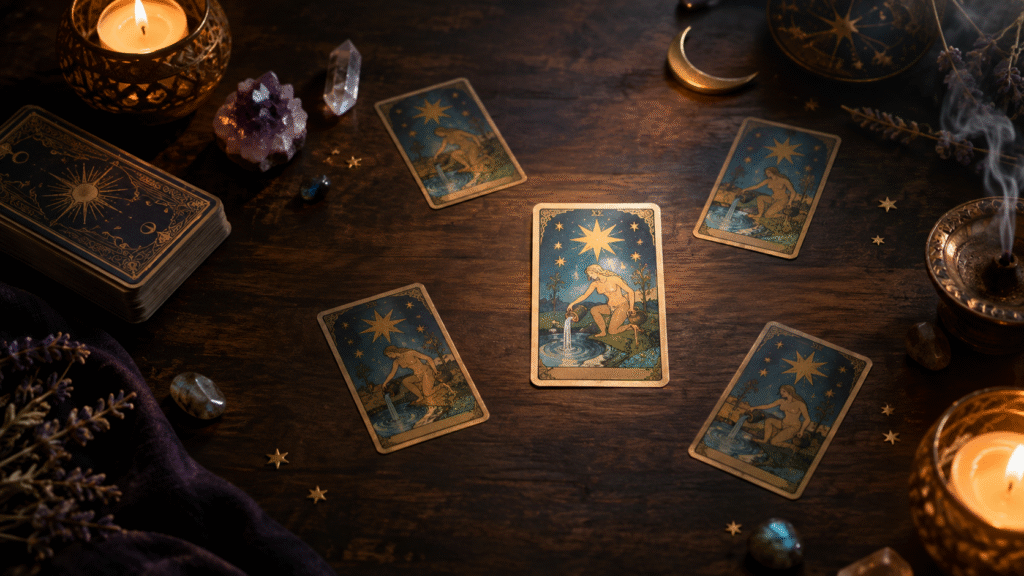
Have you ever shuffled your tarot deck, pulled one card, and then seen the same card again the next day? Maybe it appears several times during different readings. After a while, it can feel as though one particular card is following you.
The experience can be surprising, especially when the card appears during readings about different parts of your life. Some tarot readers see repeated cards as an invitation to pay closer attention to a theme. Others see them as a normal result of probability, shuffling, and the way our minds notice patterns.
So, what does it really mean when the same tarot card keeps appearing?
There is no single answer. The meaning usually depends on the card, your question, the reading context, and how you personally use tarot.
Repeated Cards Can Highlight an Important Theme
In tarot practice, repetition is often interpreted as emphasis. A card that returns may represent an issue that remains important in your current situation.
For example, someone dealing with a difficult career decision might repeatedly draw a card associated with change, patience, responsibility, or uncertainty. A tarot reader may use that repetition as a starting point for reflection.
The repeated card does not necessarily predict what will happen next. Instead, it can encourage you to examine what is already happening in your life.
Some modern tarot guides describe recurring cards as symbols of patterns that have not yet changed or received enough attention.
Your Questions May Be Repeating Too
Sometimes the card keeps appearing because the underlying question has not really changed.
You may ask, “Will this relationship work?” on Monday and then ask, “What does this person feel?” on Wednesday. Although the words are different, both questions may come from the same concern.
When the emotional issue stays the same, a similar theme can appear in the readings. The card may therefore seem unusually persistent.
Instead of immediately asking for another card, look at the questions you have been asking. You may discover that they all point toward one unresolved decision, fear, hope, or relationship.
Probability Also Plays a Role
There is a simple mathematical reason repeated cards can happen.
A standard tarot deck contains 78 cards. On one specific draw, the chance of getting one particular card is 1 in 78, or about 1.3%. However, the chance that some card will repeat becomes much higher when you make many draws. One analysis estimates that after 30 one-card draws, the probability of at least one repeated card is around 99.8%.
This distinction is important.
It is unusual to predict one exact card before drawing it. But once you draw cards repeatedly over many days, repetitions are expected. In other words, seeing the same card several times does not automatically prove that something supernatural is happening.
Mathematics alone can explain many repeated-card experiences.
Your Shuffle May Affect the Result
The way you shuffle can also influence repetition.
A tarot deck is not a computer-generated random number system. Physical cards can remain close together, especially when a person uses the same shuffle technique repeatedly. Some cards may therefore appear more often simply because of how the deck is handled.
If one card keeps appearing, try changing your shuffle method for several readings. You can also cut the deck in different places and make sure you are not accidentally drawing from the same section.
A repeated card can still feel meaningful after changing your technique, but the experiment gives you more information about whether the pattern is physical or interpretive.
Your Brain Naturally Notices Repetition
Human attention also plays a major role.
Once you notice a particular tarot card, you are more likely to remember it the next time it appears. The many cards that appear only once may quickly disappear from memory, while the recurring card becomes highly noticeable.
Psychological explanations for this type of experience include selective attention and confirmation bias. Once you expect the card to appear, each new appearance can feel more significant than it would have before you noticed the pattern.
This does not mean your experience is meaningless. It simply means that your attention influences what stands out during a reading.
What the Repeated Card Could Be Showing You
A recurring card can be used as a prompt for reflection.
Suppose The Hermit appears repeatedly. You might reflect on whether you need more personal space, quiet time, or deeper self-examination. If The Tower keeps appearing, you might consider whether an old structure, belief, or expectation in your life is changing.
These interpretations are symbolic, not scientific predictions.
The same card can also mean different things to different people. Its meaning may change depending on the question, spread position, surrounding cards, and personal circumstances.
Do Not Assume Every Repeated Card Is a Warning
A repeated tarot card can sometimes create anxiety, especially when the card has a dramatic reputation.
Cards such as Death, The Tower, or Three of Swords are often associated with difficult themes. However, their appearance does not automatically mean that a negative event will happen.
Tarot readers often interpret these cards symbolically. Death can represent endings and transformation. The Tower can represent disruption or a major change in perspective. Three of Swords can point toward grief, disappointment, or emotional honesty.
A repeating card should therefore not be treated as a guaranteed prediction.
Avoid Pulling Too Many Clarifying Cards
When the same card appears, many people immediately pull another card for clarification. Then another follows, and another.
This can create a long chain of interpretations that makes the original message harder to understand. Some contemporary tarot guidance recommends pausing rather than repeatedly drawing cards, especially when anxiety is driving the process.
Instead, write down the card and your first reaction.
Ask yourself: What was I thinking about before I drew this card? What situation in my life feels connected to its symbolism? What has not changed since my last reading?
Those questions can provide more useful insight than drawing five additional cards.
Keep a Tarot Journal
A tarot journal can help you understand recurring cards more clearly.
Record the date, your question, the card you drew, the position of the card, and your immediate interpretation. After several weeks, review your notes.
You may discover that the card appeared mostly during readings about one subject. You may also find that the repetition was less frequent than you remembered.
Keeping records can separate the actual pattern from your memory of the pattern.
So, Is the Card Really “Following” You?
The phrase is understandable, but the card is not literally following you.
Repeated tarot cards can result from ordinary probability, physical shuffling, repeated questions, and the human tendency to notice meaningful patterns. At the same time, tarot practitioners may use that repetition as a symbolic tool for reflection. The most balanced approach is to hold both ideas together.
You do not have to treat every repeat as a supernatural warning. You also do not have to dismiss the experience completely.
Instead, use the recurring card as a prompt to slow down and look more closely at what is happening in your life.
What to Do When the Same Tarot Card Appears Again
The next time the same tarot card keeps appearing, pause before reaching for another card.
Look at the card’s traditional symbolism, but also consider the question you asked, your emotional state, and the situation around you. Check whether your questions have been repeated. Consider whether your shuffle could be creating clusters.
Most importantly, ask what the card helps you notice.
Tarot can be a useful reflective practice when it encourages thoughtful questions rather than fear or certainty. A repeating card may not be proof that the future has already been decided. It may simply be a symbol that keeps giving you a reason to look at the same issue from a new angle.