
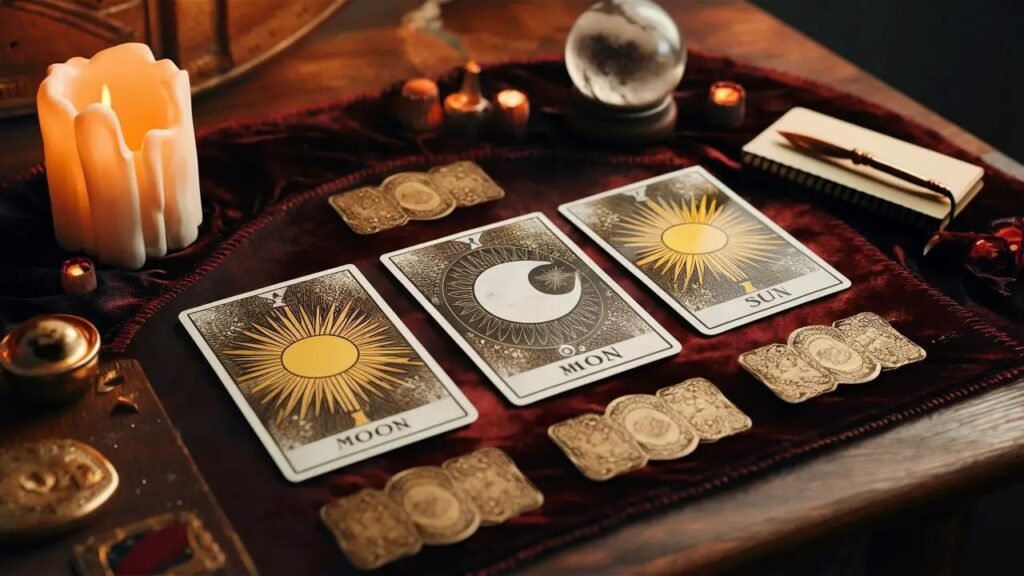
Imagine sitting down for a tarot reading, asking a question about your love life, and drawing two cards.
The first is The Sun, a card commonly associated with happiness, clarity, and positive energy.
The second is The Moon, often connected with uncertainty, hidden emotions, and confusion.
Suddenly, you feel puzzled.
Is the situation positive or uncertain? Should you feel hopeful or cautious?
This is a common experience when reading tarot.
Sometimes, two cards appear to communicate completely different messages. However, conflicting tarot cards do not necessarily mean that your reading is wrong.
Instead, they may offer different perspectives on the same situation.
Understanding how these cards work together can make tarot interpretation more meaningful.
Why Do Tarot Cards Sometimes Seem to Contradict Each Other?
Every tarot card contains multiple layers of symbolism.
A card may represent emotions, actions, opportunities, challenges, or personal attitudes.
When two cards appear together, their meanings can seem contradictory because they highlight different aspects of a situation.
For example, one card might describe your hopes while another reflects your fears.
One might represent your current circumstances, while the other suggests a possible direction.
Tarot works best as a reflective tool rather than a fixed prediction of what must happen.
The goal is not to force every card into one simple answer.
It is to explore how the different meanings might connect.
1. Two Cards Can Represent Different Sides of the Same Situation
Life is rarely completely positive or negative.
You can feel excited about a new opportunity while also feeling nervous about taking a risk.
Similarly, you might love someone while recognising that the relationship has challenges.
Tarot cards can reflect this complexity.
Example: The Sun and The Moon
The Sun may symbolise confidence, optimism, and a desire for clarity.
The Moon may represent uncertainty, emotional confusion, or information you do not yet understand.
Together, these cards could encourage you to recognise your optimism while remaining aware of unanswered questions.
They do not have to cancel each other out.
Instead, they can create a more balanced interpretation.
2. Card Positions Can Change Their Meaning
In a tarot spread, each card position provides context.
A card representing the past may have a different role from one representing the future.
For example, imagine drawing:
- Five of the Cups in the past position.
- Ace of the Cups in the future position.
The Five of Cups is commonly associated with disappointment or emotional loss.
The Ace of Cups often represents emotional renewal and new beginnings.
At first, these cards may appear contradictory.
However, their positions suggest a possible story of moving from disappointment towards emotional openness.
The cards are not necessarily predicting an outcome.
They can help you reflect on what you have experienced and what you hope to create next.
3. Opposite Cards May Reveal an Inner Conflict
Sometimes, conflicting tarot cards can represent competing desires.
You may want stability but also crave freedom.
You may desire a relationship while fearing emotional vulnerability.
Consider this combination:
The Fool + The Emperor
The Fool represents exploration, spontaneity, and new experiences.
The Emperor symbolises structure, responsibility, and boundaries.
Together, they may raise an important question:
How can you welcome new opportunities while maintaining stability?
Instead of choosing one card over the other, consider how both qualities could support your decision.
4. Tarot Cards May Reflect Different People or Perspectives
A reading about a relationship often involves more than one person’s feelings, expectations, and experiences.
Two cards may represent different perspectives within that relationship.
For example:
Queen of Cups + King of Swords
The Queen of Cups is associated with emotional sensitivity and compassion.
The King of Swords represents logic, clear thinking, and communication.
Together, these cards may encourage a balance between emotional understanding and rational discussion.
However, they cannot confirm another person’s private thoughts or intentions.
For that, honest communication is more reliable than a tarot interpretation.
5. Look at the Overall Story, Not Just Individual Cards
One of the most common tarot reading mistakes is interpreting each card separately.
A meaningful reading considers the relationship between the cards.
Ask yourself:
- What themes appear repeatedly?
- Do the cards represent different emotions?
- Is one card describing a challenge while another suggests an approach?
- How does the original question influence their meaning?
For example:
The Tower + The Star
The Tower is often associated with sudden change or the breakdown of old structures.
The Star symbolises hope, renewal, and healing.
These cards might seem opposite, but together they can suggest the possibility of finding hope after a difficult change.
This interpretation offers a reflective theme, not a guarantee that a particular event will occur.
6. Avoid Pulling Too Many Clarification Cards
When a reading feels confusing, it can be tempting to keep drawing more cards.
However, repeatedly pulling cards may create additional interpretations rather than greater clarity.
Instead, return to your original question.
Write down the cards, their positions, and your first impressions.
Then consider what each card contributes to the overall message.
If you still feel uncertain, it is perfectly acceptable to leave the reading open and revisit your reflections later.
Tarot does not need to provide an immediate answer to every question.
7. Use Tarot as a Tool for Self-Reflection
The most useful tarot readings often encourage thoughtful questions.
Instead of asking, “Which card is correct?” try asking:
What different perspectives might these cards be showing me?
For example, if you draw the Two of Wands and Four of Pentacles, you might reflect on the tension between exploring new possibilities and holding onto security.
Both themes may be relevant to your situation.
The cards can become prompts for journaling, conversation, and personal reflection.
Your decisions should still be based on your circumstances, values, and reliable information.
How to Interpret Conflicting Tarot Cards: A Simple Method
The next time two tarot cards seem to disagree, try these five steps.
Step 1: Revisit your question. Make sure you understand what you were asking.
Step 2: Check the card positions. Identify whether the cards represent different aspects of the situation.
Step 3: Find a connecting theme. Look for emotions, challenges, or choices that link the cards.
Step 4: Consider both perspectives. Avoid labelling one card as right and the other as wrong.
Step 5: Reflect before acting. Use the reading to support self-awareness rather than making decisions based on predictions alone.
This approach can make complex tarot combinations easier to understand.
Final Thoughts: Different Cards Can Tell One Meaningful Story
When two tarot cards seem to tell completely different stories, it does not automatically mean the reading has failed.
The cards may represent different emotions, perspectives, stages, or possibilities.
Just as life contains both hope and uncertainty, tarot symbolism can hold contrasting themes within one reading.
The key is to interpret the cards together rather than forcing them into a simple yes-or-no answer.
Sometimes, the most valuable insight comes from exploring the tension between two different messages.