
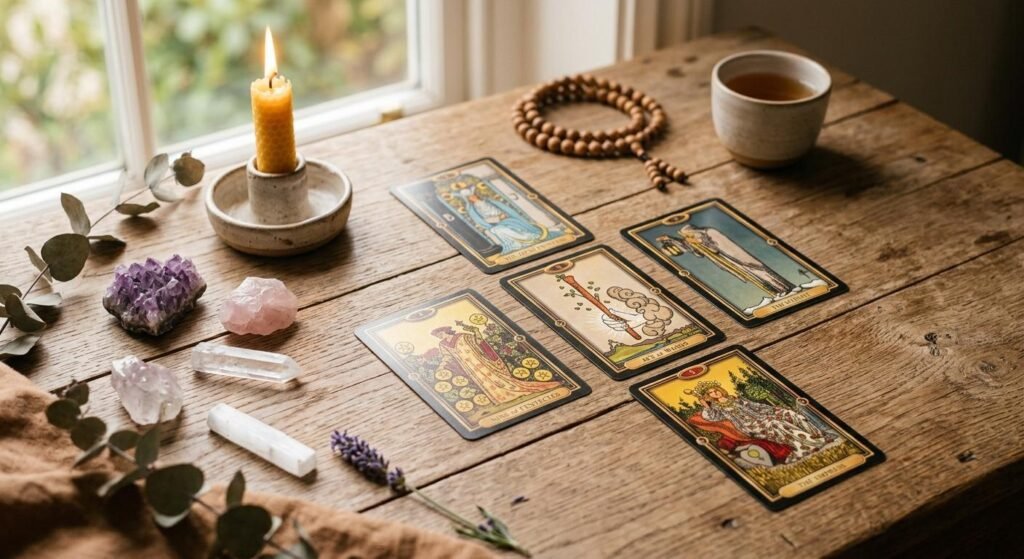
Have you ever pulled a tarot card and wondered why its meaning felt completely different from what someone else experienced?
Perhaps you received The Lovers card during a relationship reading, while your friend received the same card during a career reading. For you, it seemed connected to love. For your friend, it represented an important decision.
So, can the same tarot card mean different things to different people?
Yes. Tarot card meanings can change depending on the person’s question, circumstances, emotions, and the surrounding cards.
Although every tarot card has traditional symbolism, its interpretation is not limited to one fixed meaning.
Understanding this difference can make tarot readings more meaningful and personal.
Why Do Tarot Card Meanings Change?
A tarot deck contains 78 cards, each associated with particular themes, symbols, and traditional interpretations.
However, these meanings are not always applied in exactly the same way.
Think of a tarot card as a mirror.
Two people looking into the same mirror may notice different things because they are experiencing different situations.
Similarly, a tarot card can highlight different aspects of a person’s life.
For example, The Hermit may represent loneliness for someone struggling with isolation. For another person, it may suggest the benefits of taking time alone to reflect.
The card remains the same, but the context changes its interpretation.
1. Your Question Influences the Meaning
One of the most important factors in tarot interpretation is the question being asked.
Imagine two people drawing The Tower.
Person A asks: “What should I know about my career?”
The Tower might encourage them to examine instability at work, unexpected changes, or beliefs about job security.
Person B asks: “What is happening in my relationship?”
The same card might highlight emotional tension, a sudden realisation, or the need to rebuild trust.
The Tower does not automatically predict a breakup, job loss, or disaster.
Instead, its symbolism can be explored in relation to the question.
This is why asking thoughtful questions can help create a more useful tarot reading.
2. Personal Experiences Shape Interpretation
Everyone carries different memories, beliefs, and emotional experiences.
These experiences influence how people understand tarot symbolism.
Consider the Death card.
Someone unfamiliar with tarot might feel frightened when they see it.
However, in traditional tarot interpretation, Death commonly represents endings, transformation, and new beginnings rather than literal physical death.
For someone leaving an unhealthy habit behind, it may symbolise personal growth.
For someone moving to a new city, it might represent the end of a familiar chapter.
The same card can therefore feel reassuring to one person and challenging to another.
Neither emotional reaction should be confused with a guaranteed prediction.
3. The Same Card Can Mean Different Things in Love and Career
Tarot cards are often interpreted differently across different areas of life.
Take the Ace of Pentacles.
In a career reading, it might represent a new professional opportunity, a practical idea, or the possibility of financial growth.
In a relationship reading, it may highlight stability, commitment, or the importance of building something lasting.
In a personal development reading, it could encourage someone to establish healthier routines.
The card’s central themes remain connected to opportunity, stability, and practical beginnings.
What changes is how those themes relate to the person’s circumstances.
4. Upright and Reversed Cards Add Another Layer
Some tarot readers interpret upright and reversed cards differently.
An upright Strength card often represents courage, patience, and emotional resilience.
A reversed Strength card might suggest self-doubt, exhaustion, or difficulty trusting one’s abilities.
However, not every tarot reader uses reversals.
Some readers interpret all cards upright while considering both supportive and challenging aspects.
Neither method is universally required.
The important thing is to use a consistent approach and explain interpretations clearly.
5. Surrounding Tarot Cards Change the Message
Tarot cards are rarely interpreted in isolation during a multi-card reading.
The cards appearing beside one another can influence the overall message.
For example, The Fool appearing with the Ace of Wands may suggest excitement about beginning something new.
But The Fool appearing with the Seven of Swords could encourage someone to examine risks, missing information, or misplaced trust.
The Fool’s central symbolism involves beginnings, openness, and taking a leap.
The surrounding cards provide additional context.
This is similar to how the meaning of a word can change depending on the sentence around it.
6. Intuition Plays a Role in Tarot Readings
Many tarot readers combine traditional card meanings with intuition.
Intuition can involve noticing symbols, patterns, emotional responses, or details that seem relevant to the question.
For example, one reader may focus on the water imagery in the Queen of Cups.
Another may emphasise the card’s themes of compassion and emotional understanding.
Both interpretations can be connected to the card’s symbolism.
However, intuition should not be presented as proof that a reader knows another person’s private thoughts or can predict future events with certainty.
A thoughtful tarot reading leaves room for reflection and personal choice.
7. Your Emotional State Can Affect How You See a Card
Imagine drawing the Nine of Swords while feeling anxious about an upcoming interview.
You may immediately connect the card with your worries.
Someone else might draw it while struggling with overthinking in a relationship.
The card can encourage both people to examine their fears, but the situations are different.
This is why tarot can be useful as a reflective practice.
It may help people identify feelings and explore possible responses without treating the cards as fixed instructions.
Does This Mean Tarot Cards Can Mean Absolutely Anything?
No.
Although tarot interpretations are flexible, they are not completely random.
Traditional tarot systems provide a foundation of symbols and themes.
For example, The Sun is commonly associated with clarity, warmth, confidence, and optimism.
The Five of Cups is often connected to disappointment, grief, and recognising what remains.
A meaningful interpretation should have a clear connection to the card’s symbolism and the question being explored.
Context creates flexibility, while traditional meanings provide structure.
How Can You Understand Your Tarot Reading Better?
If you want to explore a tarot card’s meaning more deeply, try these simple steps:
- Write down the question you asked before drawing the card.
- Learn the card’s traditional meaning.
- Notice which symbols or themes stand out.
- Consider how the card relates to your current situation.
- Look at surrounding cards if you used a spread.
- Reflect on the interpretation without assuming it predicts a certain outcome.
Keeping a tarot journal can also help you recognise patterns in how you interpret cards over time.
Final Thoughts: Every Tarot Reading Is Personal
So, can the same tarot card mean different things to different people?
Absolutely.
A tarot card has traditional meanings, but its interpretation can vary according to the question, life circumstances, emotional state, and other cards in the reading.
The purpose of a thoughtful tarot reading is not simply to memorise definitions.
It is to explore symbolism in a way that encourages greater understanding, reflection, and personal awareness.
The same card may inspire courage in one person, patience in another, and a new perspective in someone else.
That is what makes tarot interpretation such a personal experience.